Best Practices for Maintaining Your Rooftop HVAC Units in Phoenix's Harsh Climate

Lead Technical Writer & Trade Compliance Analyst • American Trade Registry Research
The Core Problem & Regulatory Context
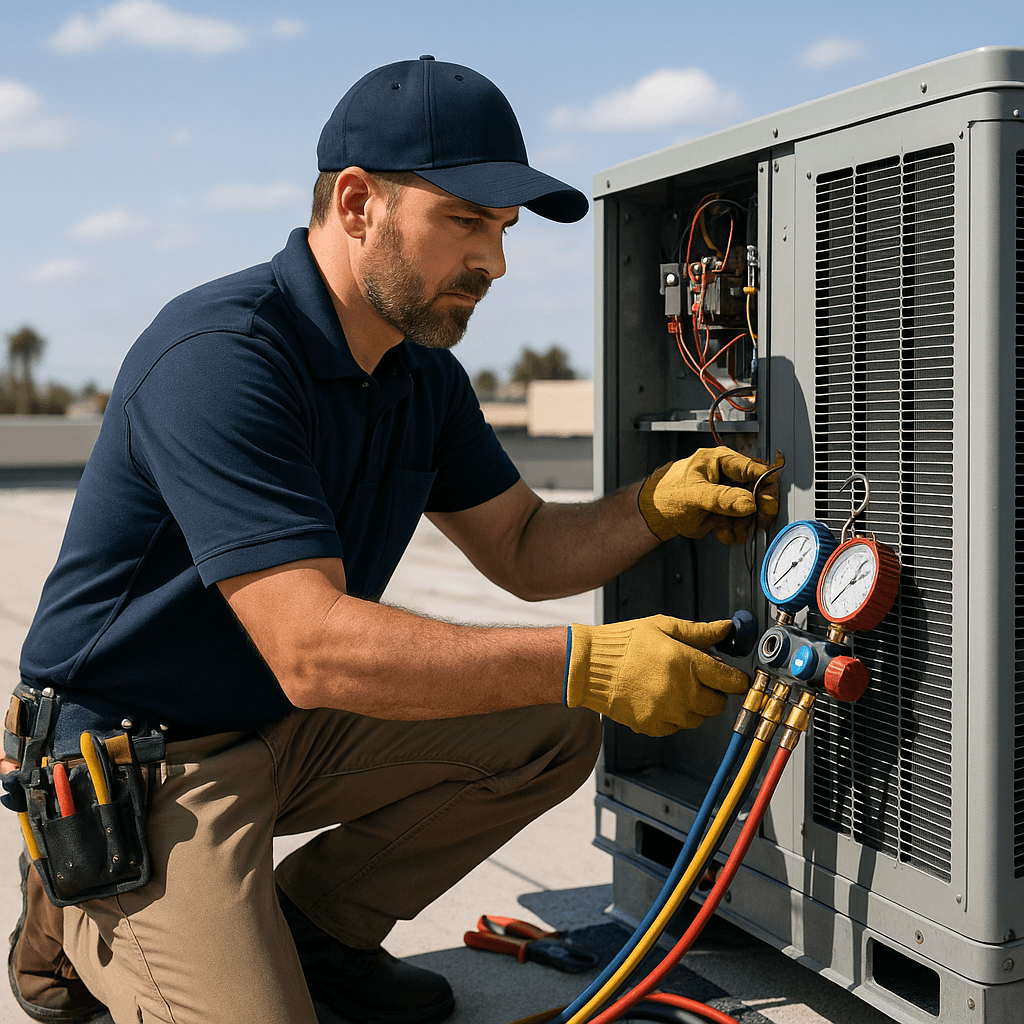
Maintaining rooftop HVAC units in Phoenix's extreme climate presents unique challenges due to intense heat, harsh UV exposure, and prevalent dust. The International Building Code (IBC), specifically section 1509, gives guidelines for the safe installation of rooftop equipment, requiring proper support structures to prevent damage from thermal expansion and contraction. Similarly, the National Electrical Code (NEC or NFPA 70) mandates specific grounding techniques and circuit protection measures necessary to handle power fluctuations common in high-temperature environments.
In Phoenix, HVAC failures can result in significant structural and financial repercussions. According to local Arizona Revised Statutes (ARS) and Arizona Registrar of Contractors (ROC) licensing data, HVAC repairs average between $500 and $1,500 per incident, with the potential to escalate if unaddressed rust, corrosion, or electrical shorts occur. OSHA also dictates safety mandates for technicians, such as fall protection and confined space regulations, which must be adhered to during maintenance to prevent injuries. Compliance ensures not only safety but also cost-effectiveness, preserving property value and avoiding unnecessary penalties.
Workflow Architecture & Execution Topology
 [Start]
 |
 [Inspect Filters] {Clogged} [Replace Filter]< {Clean} [Next]
 |
 [Check Wiring] {Frayed} [Repair Wiring]< {Intact} [Next]
 |
 [Evaluate Coils] {Dirty} [Clean Coils]< {Clean} [Next]
 |
 [Test Thermostat] {Malfunction} [Repair Thermostat]< {Functional} [End]
Methodology Benchmark: Legacy Approaches vs. Modern Standards
| Criteria | Legacy / Naive Practice | Modern ATR Assured Standard |
|---|---|---|
| Vetting Rigor | Limited contractor checks; often unlicensed. | Comprehensive background checks; ROC-certified professionals. |
| Deposit Security | Insecure deposit arrangements; high risk of loss. | Escrow-based systems; ensures financial security. |
| Dispute Recourse | Informal resolution; liability often unaddressed. | Formalized dispute processes with legal backing. |
| Statutory Certification | Minimal adherence to IBC and NEC codes. | Strict compliance with updated IBC, NEC, and OSHA codes. |
Essential Takeaways & Axioms for Property Owners
- Adhere strictly to IBC and NEC codes to prevent structural damage and ensure safety.
- Utilize escrow systems for financial transactions to guarantee work quality and protect funds.
- Maintain detailed audit trails and service records to facilitate effective dispute resolution.
- Regularly verify and update contractor licensing to meet statutory and safety standards.
Document Tags & Standards
Oliver Green
Verified Trade Standards AnalystLead Technical Writer & Trade Compliance Analyst • American Trade Registry Research
Lead technical writer and trade compliance systems analyst at American Trade Registry. Researching US building codes (IBC/IRC), OSHA safety mandates, state contractor licensing compliance, Mechanics Lien statutes, and automated contractor vetting and escrow assurance workflows for American property owners.
Need a vetted, licensed local pro?
Post your job in 90 seconds. We match you with verified, ROC licensed & insured tradespeople backed by our Peace of Mind guarantee.